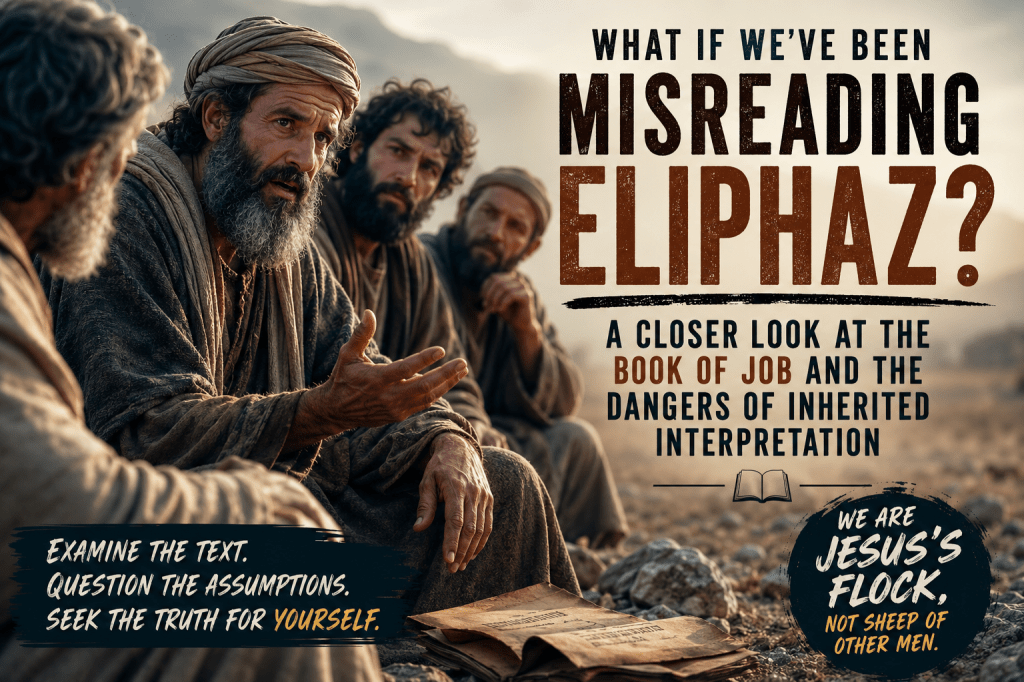
Hey dudes, here’s something that’s been on my mind lately during my Bible studies in the morning while reading through Book of Job. I think people may be way too hard on Eliphaz. Seriously. Everybody talks about Job’s friends like they were basically calling him a secret monster the entire time. But when I slowed down and actually read the text carefully for myself, I started noticing something. Eliphaz does not actually say a lot of the things people claim he says.
First off, the guy clearly cared about Job deeply. That matters. Before he even speaks, he travels to see his friend, breaks down crying, tears his robe, and sits silently with him for seven days. Seven days. Most people cannot sit with somebody hurting for seven minutes without reaching for their phone. This was not some smug fake spiritual guy showing up to attack Job. The text does not present Eliphaz that way at all. And nowhere are we told he was some corrupt or ungodly man either. Job is uniquely righteous, yes. But the story never says Eliphaz was beneath him morally. If anything, he comes across like a deeply serious and devout man whose understanding of suffering just got shattered in real time.
Then look at what he actually says. Slowly. Carefully. It sounds way less like, “Job, what evil thing did you secretly do?” and way more like, “Man, none of us are above suffering because none of us are perfect.” That is a huge difference. Eliphaz keeps circling back to the weakness of humanity. Human limitation. Human brokenness. God’s greatness. He talks about how nobody is fully righteous before God. That theme comes up over and over.
And here is the part that really changed things for me. Look at what Eliphaz does not say. He never accuses Job of stealing. Never says he abused people. Never says he worshiped idols in secret. Never points to some hidden scandal. Nothing. If he truly believed Job committed some obvious wicked act, why not just say it? Instead, he speaks in broad terms about mankind itself. Suffering. Frailty. Sinfulness. Human limitation before God. That feels far more connected to the fallen condition of humanity than to some direct accusation against Job personally.
People also skip over something massive near the end of the book. God never directly corrects Eliphaz’s core theology. Think about that. This is an Old Testament wisdom book where God literally shows up and speaks at length. If God wanted to clearly say, “Eliphaz, suffering has absolutely nothing to do with the fallen nature of humanity,” He could have done it instantly. But He never does. God never says humans are not broken. He never says suffering is disconnected from mankind’s fallen condition. A lot of Eliphaz’s actual theological points remain untouched.
That is why I think a giant interpretation echo chamber has formed around this book. I had inherited the same interpretation everybody else did. It never even crossed my mind to question it. Then I started spending real quiet time in the mornings reading Job slowly for myself instead of just reading what everybody else said about Job. And suddenly I realized the text might be saying something deeper than the standard sermon version people repeat.
Maybe the bigger point is not that Eliphaz was falsely accusing Job of secret evil. Maybe the bigger point is that even righteous people still live inside a fallen human condition where suffering exists. That changes the entire tone of the discussion. It makes the book broader. Heavier. More universal.
I think this is a warning for Christians in general too. Interpretations get repeated so often that eventually people stop checking the text itself. Commentaries repeat pastors. Pastors repeat scholars. Churches repeat traditions. Then assumptions harden into “facts.” Meanwhile the actual wording on the page may be saying something far more nuanced.
That is why believers have to spend real time wrestling personally with Scripture instead of automatically inheriting every popular interpretation handed down to them. Sometimes the biggest truths are hiding in the things the text quietly never says.
We are Jesus’s flock, not sheep of other men.
 Jordan Tate