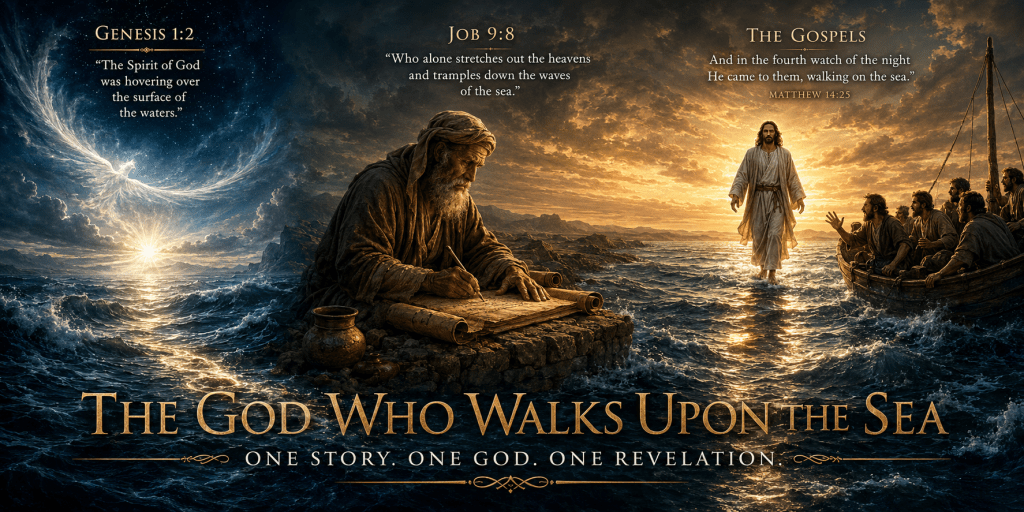
One of the most common explanations offered for the connections between the Old and New Testaments is coincidence. The Bible, we are told, is simply a collection of religious writings composed by different authors over many centuries. Similar themes are inevitable. Later writers naturally borrowed ideas from earlier ones. Any apparent foreshadowing is merely the result of creative interpretation.
At first glance, that explanation sounds reasonable.
The problem is that certain passages refuse to fit neatly into it. Job 9 is one of them.
This chapter is not usually listed among the famous Messianic prophecies. It contains no prediction of Bethlehem, no mention of a virgin birth, and no explicit forecast of a coming king. Yet buried within Job’s lament are ideas that align so closely with Jesus Christ that they demand an explanation.
Job was wrestling with questions that reach to the very heart of the human condition. His suffering had stripped away easy answers. He knew God was just. He knew God was powerful. He knew God was holy. What he could not understand was how a finite and imperfect human being could ever stand before such a God.
As he reflects on this dilemma, Job writes:
“For He is not a man as I am that I may answer Him, that we may go to court together. There is no mediator between us, who can lay his hand upon us both.”
— Job 9:32–33 (NASB 2020)
This is one of the most remarkable statements in the entire book.
Job does not merely want relief from suffering. He does not ask for a better argument or additional evidence. He identifies a much deeper problem. There is a gulf between God and man, and he recognizes that neither side can be brought together by human effort alone. What is needed is a mediator—someone who can stand between both parties and reconcile them.
This longing lies at the center of Christianity.
Centuries after Job, the New Testament would present Jesus Christ as the unique mediator between God and humanity. Not merely a prophet representing God to man. Not merely a man seeking God. Rather, the God-man who unites both realities in His own person.
Whether one accepts Christianity or not, the parallel is striking. Job identifies the need long before the New Testament presents what Christians believe is the answer.
Yet the most fascinating connection in Job 9 may be found earlier in the chapter.
Describing the majesty of God, Job writes:
“Who alone stretches out the heavens and tramples down the waves of the sea.”
— Job 9:8 (NASB 2020)
The wording deserves careful attention.
Job does not simply say that God controls the sea. Scripture says that in many places. Nor does he merely say that God created it. Instead, Job describes God as One who treads upon the waves.
Even more significantly, he says God does this alone.
To understand the force of that statement, we must remember what the sea represented in the ancient world. It was a place of danger, chaos, uncertainty, and overwhelming power. Human beings crossed it at great risk. Storms could arise without warning. Entire lives could be swallowed in moments.
Yet throughout Scripture the waters remain under God’s authority.
This theme appears from the opening chapter of the Bible:
“And the Spirit of God was hovering over the surface of the waters.”
— Genesis 1:2 (NASB 2020)
Before dry land appears, before life is formed, and before order emerges from chaos, God’s Spirit is present over the waters. The message is unmistakable. The waters are not rivals to God’s authority. They exist beneath it.
The same imagery appears again in the Psalms:
“Your way was in the sea and Your paths in the mighty waters, and Your footprints may not be known.”
— Psalm 77:19 (NASB 2020)
The psalmist is reflecting on God’s mighty acts of deliverance. Yet the language is noteworthy. God’s path is in the sea. His footprints are in the mighty waters. The image is not merely one of control from a distance. It is a picture of God moving through the waters as their sovereign Lord.
With these passages in mind, we arrive at the New Testament.
Matthew records that the disciples were caught in a storm on the Sea of Galilee. The wind was against them. The waves were battering their boat. Then, in the darkness before dawn, something happened that none of them expected:
“And in the fourth watch of the night He came to them, walking on the sea.”
— Matthew 14:25 (NASB 2020)
Matthew provides the fullest account of the event. He alone records Peter stepping out of the boat and briefly walking on the water before fear overcomes his faith. The story concludes with the disciples worshiping Jesus and declaring:
“You are certainly God’s Son!”
— Matthew 14:33 (NASB 2020)
Mark records the same event but includes an unusual detail:
“Seeing them straining at the oars, for the wind was against them, at about the fourth watch of the night He came to them, walking on the sea; and He intended to pass by them.”
— Mark 6:48 (NASB 2020)
That phrase—“He intended to pass by them”—has puzzled readers for centuries. Yet it echoes Old Testament moments in which God “passed by” Moses and Elijah as a revelation of His glory. Mark’s emphasis appears to be less on the miracle itself and more on what the miracle reveals about Jesus.
John’s account is shorter but contributes another important detail:
“Then they were willing to take Him into the boat, and immediately the boat was at the land to which they were going.”
— John 6:21 (NASB 2020)
Before entering the boat, Jesus tells the frightened disciples:
“It is I; do not be afraid.”
— John 6:20 (NASB 2020)
The Greek phrase translated “It is I” is literally ego eimi—“I am.” Throughout John’s Gospel, those words repeatedly carry theological significance as Jesus reveals His identity.
What is fascinating about these accounts is that they differ in emphasis while agreeing completely on the central event. Matthew highlights faith and worship. Mark highlights revelation. John highlights identity. Such variation is exactly what historians expect from authentic eyewitness testimony. Different witnesses remember and emphasize different details while preserving the same core event.
And the core event is undeniable.
Jesus walked upon the sea.
At this point, the connection to Job becomes difficult to ignore.
Job says that God alone treads upon the waves.
Psalm 77 describes God’s path through the mighty waters.
Genesis depicts God’s Spirit over the waters from the beginning of creation.
Then Jesus comes walking across the Sea of Galilee.
The miracle therefore functions as more than a demonstration of supernatural power. Prophets performed miracles. Moses performed miracles. Elijah performed miracles. Yet none of them are presented as walking upon the sea as a revelation of who they are.
Jesus does not merely command the waters.
He walks upon them.
The Gospels present this act as evidence of His divine identity. The One who comes striding across the waves is doing what Job attributed to God Himself centuries earlier.
Of course, a skeptic may still insist that all of this is coincidence. That is certainly possible. Yet coincidence becomes a less satisfying explanation as the evidence accumulates. Job longs for a mediator; Christianity proclaims a mediator. Job describes God walking upon the sea; Jesus walks upon the sea. The Old Testament repeatedly associates mastery over the waters with the Lord; the New Testament repeatedly presents Jesus exercising that mastery.
Any single connection might be dismissed.
A pattern is another matter.
Job could not have known the details of Christ’s coming. Sitting among the ashes of his suffering, he could not see Bethlehem, Galilee, Calvary, or the empty tomb. Yet his words reached far beyond his own generation. He identified humanity’s need for a mediator. He described God as the One who treads upon the waves. Without realizing it, he left fingerprints that point toward Christ.
That is why Job 9 is far more than a chapter about suffering. It is a chapter about longing, identity, and revelation. It raises questions that the New Testament later answers. It presents images that find their fulfillment in Jesus.
And among those images stands one of the most compelling in all of Scripture: the God who walks upon the sea stepping into His own creation and coming to His people through the storm.
 Jordan Tate