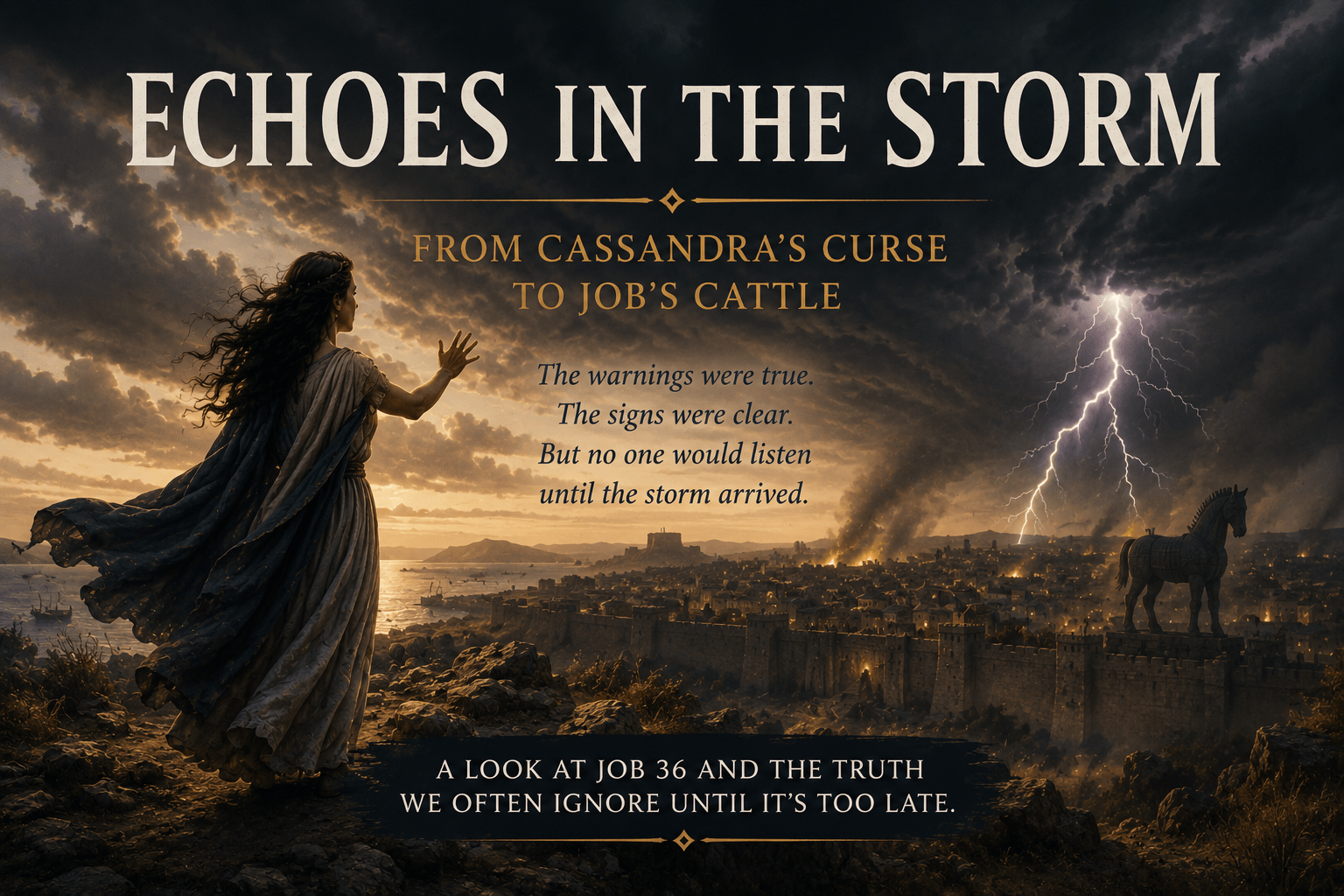
History, myth, and theology are filled with warnings people choose to ignore.
Sometimes the warning comes through a prophet. Sometimes through a young voice dismissed by older men. Sometimes through a storm gathering slowly on the horizon while everyone keeps arguing beneath the darkening sky.
In Greek mythology, Cassandra was cursed to speak the truth and never be believed. In the Book of Job, Elihu stands in a similar literary space. He sees something the others are missing. He senses that the argument has gone in circles long enough. He speaks with urgency, frustration, and awe because the storm is no longer theoretical. It is approaching.
And then, immediately after he speaks, the Lord answers Job out of the whirlwind.
Cassandra and the Curse of Being Right Too Early
Cassandra was a princess of Troy who received the gift of prophecy from Apollo. But when she rejected him, Apollo cursed her. She would still speak the truth, but no one would believe her.
That curse became her torment.
She warned that Paris would bring destruction to Troy. She warned against bringing the wooden horse into the city. She saw the disaster before it happened, but her people dismissed her as unstable, dramatic, or mad. Troy celebrated while Cassandra grieved. She could see the fire coming, but no one would listen until the city was already burning.
This is why the “Cassandra phenomenon” still matters. It describes the painful experience of giving true warnings that are rejected because they are inconvenient. People often resist warnings that disrupt their plans, challenge their pride, or threaten the illusion that things are stable.
The problem is not always a lack of evidence. Sometimes the problem is that the truth arrives before people are emotionally ready to receive it.
Elihu Enters the Ashes
The Book of Job gives us another version of this pattern.
For most of the book, Job and his three friends argue in circles. The friends insist Job must have sinned. Job insists he wants to bring his case before God. Their debate becomes exhausting, repetitive, and spiritually dangerous. They speak about God, but they do not seem to perceive what God is about to do.
Then Elihu appears.
He is younger than the others, and he admits that his age made him hesitant to speak. “I am young in years, and you are old; therefore I was timid and afraid to tell you what I know” (Job 32:6). But he can no longer stay silent. He compares himself to wine with no vent, like new wineskins ready to burst (Job 32:19).
That image matters. Elihu is not calmly entering a debate club. He is a bursting vessel. He has listened long enough. He believes both Job and the friends have missed something essential, and the pressure of that truth has become unbearable.
Like Cassandra, Elihu is positioned as an urgent voice before catastrophe, revelation, or judgment. He is not warning of Troy’s destruction, but of something more terrifying: the nearness of God.
The Storm Is Not Just Weather
As Elihu’s speech develops, his focus shifts upward. He begins speaking of clouds, thunder, lightning, rain, and the terrifying majesty of God. His words become storm language.
He asks, “Can anyone understand the spreading of the clouds, the thundering of His pavilion?” (Job 36:29). He describes God covering His hands with lightning and commanding it to strike its mark. The atmosphere of the passage begins to change. Elihu is no longer merely arguing theology. He is reading the sky.
Then comes the strange and memorable line in Job 36:33:
“His thunder announces the coming storm; even the cattle make known its approach.”
The verse is difficult to translate, and different English versions handle it differently. Some retain the image of cattle sensing the storm. Others focus more on God’s wrath or zeal. Either way, the effect is striking. Elihu is saying that creation itself is reacting to the movement of God.
The thunder announces Him. The sky testifies. Even the earth seems to know something is coming.
And yet Job and his friends remain silent.
The Warning No One Answers
One of the most fascinating things about Elihu is that no one answers him.
Job answered Eliphaz, Bildad, and Zophar repeatedly. The debate had a rhythm. Speech, response, counterargument, complaint. But after Elihu speaks, there is no recorded rebuttal from Job. There is no interruption from the friends. No one says, “You are right.” No one says, “You are wrong.”
The narrative simply moves forward.
And then Job 38 begins:
“Then the Lord answered Job out of the whirlwind.”
That transition is stunning. Elihu has been speaking of storm, thunder, lightning, and the approaching majesty of God. Then God speaks from the very storm Elihu has been describing.
This does not mean we should treat every word of Elihu as perfect. But literarily, he is doing something important. He prepares the reader for the arrival of God. While everyone else has been trapped in arguments about suffering, guilt, justice, and reputation, Elihu has started pointing toward the sky.
He senses the shift before the others do.
The Human Failure to Read the Signs
This is where Cassandra and Elihu meet.
Cassandra warned Troy, but Troy preferred celebration. Elihu warned Job and the friends, but the text gives no human response. In both cases, the truth appears before the crisis is fully visible. The warning comes while people still have time to humble themselves.
But human beings often do not listen when the warning challenges their assumptions.
We dismiss what comes from the wrong person. Cassandra was dismissed as mad. Elihu could have been dismissed as young. We dismiss what makes us uncomfortable. We dismiss what interrupts the story we are trying to tell ourselves.
And sometimes, by the time the warning becomes undeniable, the storm has already arrived.
The Takeaway
The deepest danger is not that God fails to speak. The danger is that we become too proud, too distracted, or too invested in our own explanations to hear the warning before the whirlwind.
Cassandra saw Troy burning before the flames appeared. Elihu sensed the storm before the Lord spoke from it. Both remind us that truth often arrives before confirmation, and humility is the only posture that can receive it in time.
The sky was darkening. The thunder was already speaking. Elihu could read the atmosphere.
The question is whether we can.
 Jordan Tate