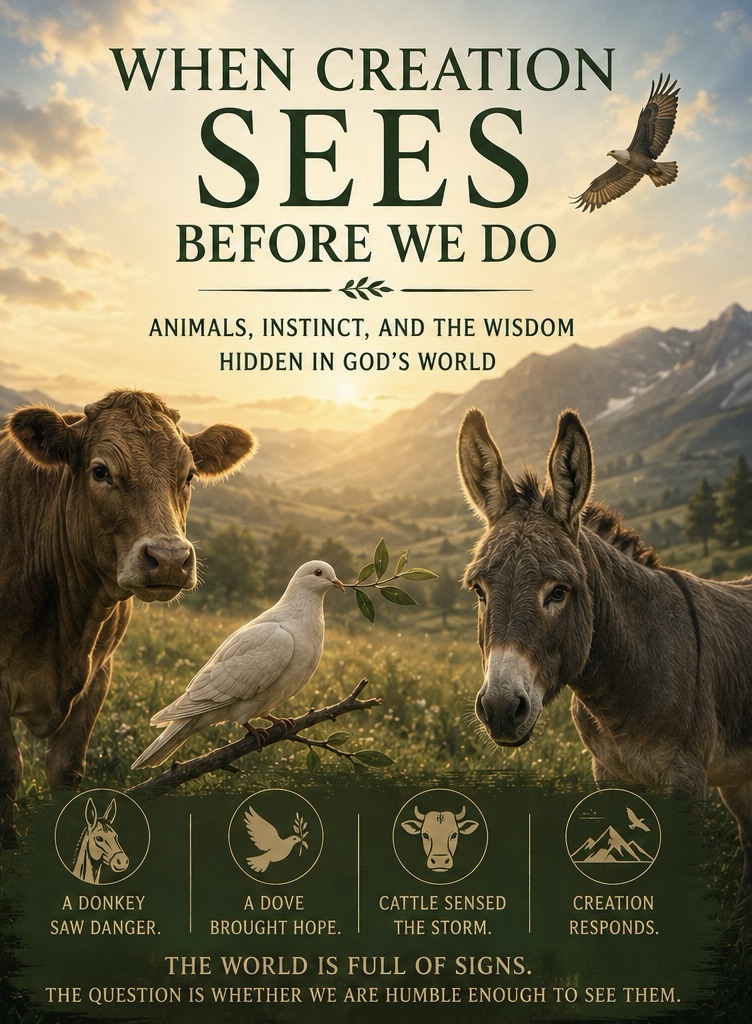
One of the most humbling patterns in Scripture is that animals sometimes perceive what human beings miss.
That sounds strange at first. Humans are made in the image of God. We reason, speak, worship, build, interpret, and reflect. Yet the Bible repeatedly shows that intellect does not always equal perception. Sometimes the creatures we consider lower than ourselves respond more faithfully to reality than we do.
They do not overexplain. They do not defend their pride. They do not build arguments to protect their egos. They simply respond to the world God made.
And sometimes, that makes them wiser than us.
Balaam’s Donkey Saw the Angel
One of the clearest examples is Balaam’s donkey.
Balaam was a prophet, yet on the road he failed to see the angel of the Lord standing before him with a drawn sword. His donkey saw what he did not. Three times she turned aside, and three times Balaam beat her because he thought she was the problem.
But the animal was not the problem. The animal was perceiving reality.
Balaam had spiritual status, religious language, and prophetic reputation. But in that moment, the donkey had clearer sight. The irony is sharp and almost comedic. The prophet was blind, and the beast could see.
That story exposes something uncomfortable. Spiritual blindness is not always caused by a lack of information. Sometimes it is caused by desire, ambition, anger, or pride. Balaam could not see because his heart was already leaning in the wrong direction.
The donkey did not have theological vocabulary, but she recognized danger.
The Animals After the Flood
After the flood, Noah sends out birds to discern the condition of the earth. The raven goes out. Then the dove is sent. Eventually the dove returns with an olive leaf, signaling that the waters have receded.
Here again, an animal becomes part of the process of discernment.
Noah cannot simply look out and know the full condition of the renewed world. He waits. He watches. He receives a sign through creation. The dove becomes a messenger of transition, a living witness that judgment has passed and new ground is emerging.
The image is gentle but powerful. God’s world is not mute. Creation carries signs. The wise person learns to notice them.
Elihu’s Cattle and the Coming Storm
In Job 36, Elihu speaks of God’s majesty in the storm. He describes clouds, thunder, lightning, and the terrifying power of God’s presence. Then he says something strange:
“His thunder announces the coming storm; even the cattle make known its approach.”
The verse is difficult to translate, and some versions understand the Hebrew differently. But the traditional image of cattle sensing the storm remains deeply meaningful.
Farmers have long observed that animals may become restless or seek shelter before severe weather. Whether through pressure changes, sound, smell, or subtle atmospheric cues, animals often respond to signs humans overlook.
In Job, that image becomes theological.
The cattle sense what is coming. The thunder announces it. Creation responds to the movement of God. Meanwhile, Job and his friends have been locked in human argument, trying to explain suffering from the ground up.
The cattle are not writing theology. But they are reading the atmosphere.
God’s Wild Kingdom in Job 38 and 39
When God finally answers Job out of the whirlwind, He does not begin by explaining the hidden reasons behind Job’s suffering. He does not hand Job a legal document. He does not satisfy every question Job has raised.
Instead, God takes Job on a tour of creation.
He speaks of lions and ravens. Mountain goats giving birth in the wild. The untamed donkey. The ostrich. The horse. The hawk. The eagle.
This is not random nature poetry. God is dismantling Job’s assumption that reality must be understandable from his limited point of view. Creation is full of wisdom Job did not design and cannot govern.
The wild animals live within patterns Job cannot control. They survive by instincts he did not give them. They inhabit a world ordered by God’s wisdom, not human comprehension.
God is not saying Job’s suffering does not matter. He is showing Job that the universe is much larger, wilder, and more mysterious than Job’s courtroom categories can contain.
Jesus and the Signs of the Times
This theme continues into the teaching of Jesus.
Jesus rebukes people who can interpret the weather but cannot discern the signs of the times. They know how to read the sky, but they cannot recognize the spiritual meaning of what is happening in front of them.
That is a devastating diagnosis.
Human beings can become skilled at practical observation while remaining spiritually blind. We can notice clouds and miss Christ. We can predict rain and fail to recognize visitation. We can study the world and still resist the God who made it.
The issue is not intelligence. It is humility.
Creation Obeys While Humanity Argues
The Bible often portrays creation as responsive to God.
The sea parts. The ravens feed Elijah. The fish swallows Jonah. The rooster crows after Peter’s denial. The stones are ready to cry out if human praise falls silent.
Again and again, creation moves at the command of God.
Human beings, meanwhile, argue.
We question, resist, delay, rationalize, and explain ourselves. We are capable of great wisdom, but also great blindness. Animals do not bear the image of God the way humans do, but they often reveal the tragedy of humans refusing to live like those who do.
Creation listens better than we do.
The Takeaway
The biblical point is not that animals are morally superior to people. The point is that God has woven wisdom into the world, and pride keeps us from noticing it.
Balaam’s donkey saw the angel. Noah’s dove recognized the new world emerging. Elihu’s cattle sensed the storm. The animals of Job lived by instincts beyond human control. Jesus warned that people could read the weather and still miss the hour of God’s visitation.
Creation is not silent. It is full of signs.
The question is whether we are humble enough to see what the animals already know: the world belongs to God, and wisdom begins when we stop pretending we are the ones holding it together.
 Jordan Tate